Wouldn't get past about 300 degrees whatever we set. Bake element tested weak under load. Holds temperature properly now.
Peregrine A.
A crawling preheat, one side burning while the other stays pale, or a dead display, typically comes down to one part rather than the whole appliance.
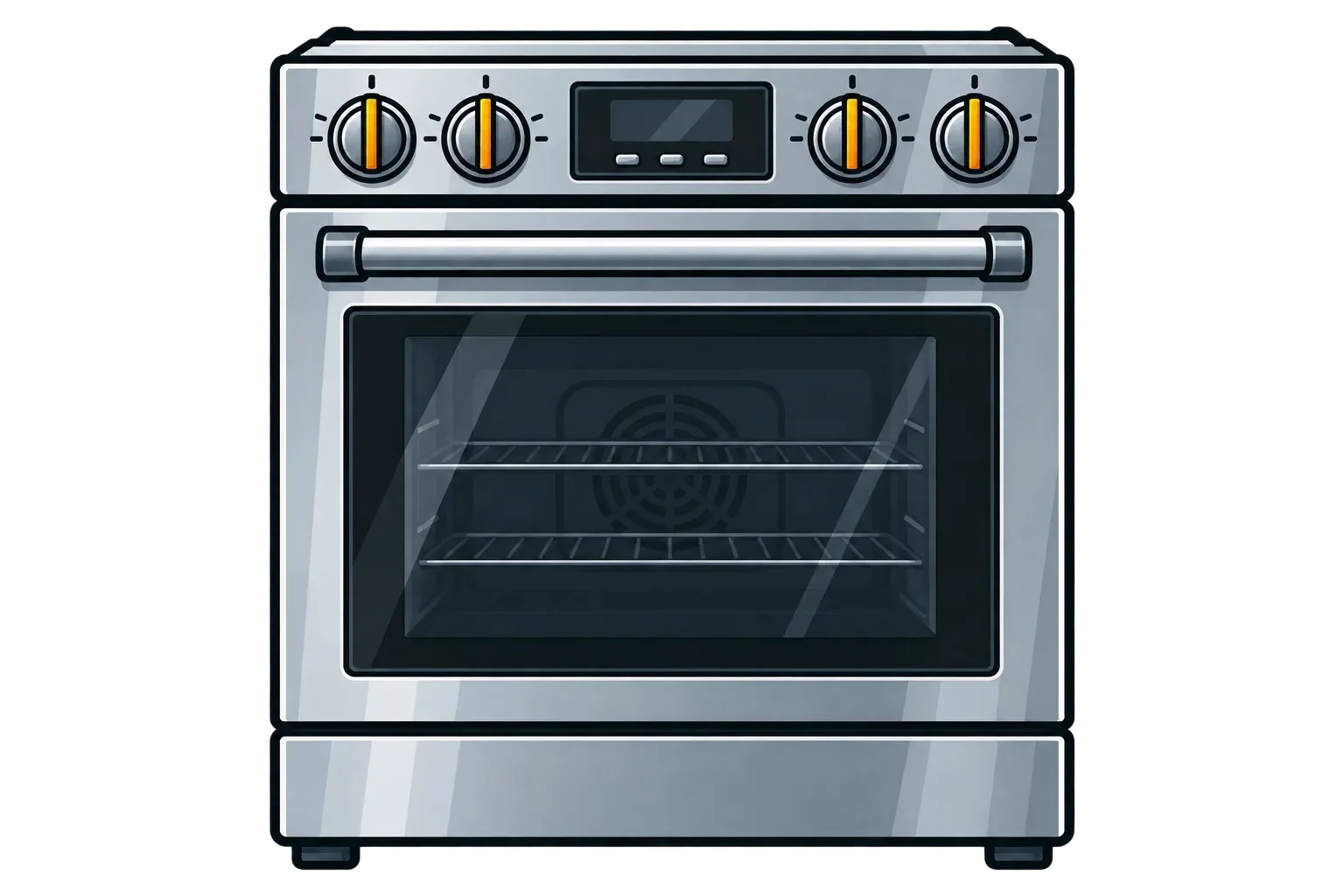
Six things that bring people to our door, and the cause we most often find.
Dial says 375, the roast says otherwise. On an electric oven a weakened bake element is the prime suspect; on gas it's a tired igniter. We measure the output under real load, because appearance tells you almost nothing.
What took ten minutes now takes twenty. Rarely a sudden break, more often a slow fade in the igniter or element. A single temperature reading won't catch that, so we watch the whole preheat curve.
Tray dead center and still one side comes out darker. A convection fan that has stopped turning leaves hot air stagnant. A heating element with a weak patch does something similar. A test bake shows us where the imbalance sits.
Hover your palm by the door edge mid-bake. Heat you can feel escaping suggests the door seal has gone out of shape or the hinges have slackened. Both are usually worn together, and fixing only one leaves the job half done.
Buttons do nothing, the display is black. The board itself is rarely the problem, it's typically a ribbon connector behind the panel that's crept loose. Reseating it is a quick fix, provided we check it first.
The cycle stalls or shows an error, and sometimes the door stays locked afterward. Look at the lock switch, which may trigger in the wrong order and get flagged as a hazard. Testing that order directly beats forcing a reset that won't stick.
Still Not Sure?
One phone call gets you a straight answer, most jobs wrap up in a single visit.










Manufacturers label these their own way, but the same handful of signals keep showing up.
Manufacturers each use their own system, so read this as a rough guide, not a substitute for your manual. If the same one comes back after you cut the power for a minute, get a technician out to read it properly.
What customers said after we sorted out their oven.
A fair share of what we see turns out to be something quick and safe enough to rule out yourself, no tools needed.
Try an oven thermometer. A cheap one shows whether the real temperature matches the dial. A gap over 25 degrees is worth mentioning.
Feel around the door. Run a hand along the edge while it heats. Escaping warmth often means a flattened gasket.
Confirm power or gas. Electric ovens need the breaker on. Gas ovens need the valve fully open.
Rule out a locked self-clean. If the door won't open, see whether the cycle is still running or hasn't released.
Wipe the racks. Built-up grime stops them sliding, which people sometimes mistake for a hinge problem.
Reset breakers after a storm. A partial power dip can upset the board. Reset and see if the display wakes.
Still no luck after trying these? Time to have someone take a proper look. Book a technician and we'll take it from there.
Wherever you are on this list, a truck's usually within easy reach the same day.
Book NowSend your details over and we'll follow up to lock in a time that works, most repairs settled the same day.
Drop your details below and a real person will call you back soon.
Thank You!
Your message has been sent successfully. We'll get back to you shortly.
Thank You!
Your message has been sent successfully. We'll get back to you shortly.
Prefer to talk it through? (289) 321-3253